Inside Venture Capital's War Machine
Investments in AI "defense" startups are soaring. More innocents could die, but these guys stand to make a fortune.


RO KHANNA IS often called the Congressman for Silicon Valley. But he’s also a progressive Democrat who has recently found himself in the cross-hairs of the tech industry, which has swung to the right in the Trump era.
So when Khanna posted on X that he had voted “no” on a $838.7 billion defense funding bill that would continue to offer billions in arms sales to Israel, the statement provoked an immediate backlash from several of Israel’s staunchest supporters in the financial industry.
Few, however, could match the vitriol of Josh Wolfe, the co-founder of VC firm Lux Capital who, by the way, lives in New York City, not Silicon Valley.
“Ro is a mental moron or an intentional liar,” he wrote on X. “WHAT A MENTAL MORON,” he repeated, in his hyperbolic all-caps style.
Wolfe—who likes to say that “chips on shoulders put chips in pockets”—isn’t shy about calling people names on X. To him, former Obama Deputy National Security Advisor Ben Rhodes is a “traitorous Iranian asset” for opposing the US foreign policy of unconditional support for Israel. And UN Secretary General Antonio Guterres, who condemned the military escalation in the Middle East by the US and Israel as well as Iran’s retaliation, is simply “a worthless irrelevant person.”
I could go on and on, but the point Wolfe wanted to get across to Khanna is that sending money to Israel is “good” since eventually American defense companies are profiting from it.
“It ain’t charity “AID” to Israel! Ro voted NO on AMERICA making money OFF OF Israel,” he posted.
Actually, it’s Josh Wolfe—and all the other financiers investing in the war machine—who stand to profit from this roundtrip of dollars, as well as the rest of the Pentagon budget.
Congress has proposed a Department of War budget this year close to $1 trillion, with $167 billion of that in procurement for weapons and systems and another $145 billion in new technologies and equipment. But as the US depletes its military arsenal after years of supporting Ukraine, then Israel and now bombing Iran on a daily basis, Trump wants taxpayers to cough up more money. He is asking for a total of $1.5 trillion.
You might think that money is going to Lockheed or Raytheon, and it certainly will now that the Pentagon is running out of munitions due to our carpet bombing of Iran. But the Silicon Valley billionaires behind the Trump administration have convinced the president that the future of the military is in artificial intelligence, and they are getting their fair share of dollars.
The use of AI in the theater of war, however, is particularly worrisome given its known capacity for failure or errors, which are called “hallucinations.” In war, these can be deadly, and questions are already being raised about whether AI is causing grievous harm in the war on Iran.
“IS AI ALREADY killing people by accident?” longtime AI critic Gary Marcus asked on this platform when the Wall Street Journal reported that Anthropic’s “Claude” was being used by the US military for target identification in Iran. The question is whether Claude mis-targeted the girls’ school that killed more than 175 people, mostly little girls between the ages of 7 and 12, which inflamed the Iranian public and is likely a war crime. Days later, a missile struck a park in Tehran called “Police Park,” leading Iranian expert Trita Parsi to question whether the park (which has nothing to do with the police) was misidentified as a government building by AI since the US is targeting all government structures in Iran.
But do the US or Israeli governments care if AI murders the innocent? US Department of War Secretary Pete Hegseth has all but said “no.” And more than two years ago the Israeli-Palestinian magazine +972 reported that an AI program called Lavender was responsible for killing children and families in Gaza, but the expose did not stop the slaughter from continuing.
Certainly none of these deaths are likely to quell the excitement in the VC world. During the first year of Trump’s second term, the value of so-called defense tech startups reached record-breaking valuations of $49 billion, almost double the 2024 totals, according to PitchBook, which tracks the industry.
Anduril Industries, the leader in what is being labeled a “defense tech supercycle,” is now said to be worth $60 billion—more than all of the defense startups put together in 2025. Its backers include some of the biggest, most influential VCs and their billionaire owners, including Peter Thiel’s Founders Fund, Marc Andreessen and Ben Horowitz’s A16z, Josh Kushner’s Thrive Capital, and Lux, which first invested in Anduril in 2017.
The tech company is creating autonomous vehicles for every potential battlefield. As Wolfe told me recently for an article in Institutional Investor, “They now are in every domain—air, land, sea, space, cyber.”
Lucky Palmer, Anduril’s 33-year-old founder who calls himself a “radical Zionist,” takes credit for convincing Trump to rename the Department of Defense the Department of War, according to a mostly glowing profile of him in The New York Times. (He wears Hawaiian shirts!). But Anduril—whose executives are busy donating to military adjacent candidates in this year’s Congressional races—has already received some criticism. For one thing, its technology has been used by border control agents to target immigrants with “laser sensors that could track people’s movements and try to identify them,” the Times reported. It also said that some of Anduril’s weapons have underperformed:
Whether [Palmer] can effectively carry out his vision of autonomous warfare is unclear. Anduril has produced only small numbers of weapons for the U.S. military. Some drone and missile tests that the company conducted in Ukraine in recent years were disappointing.
Lux, which has $9.4 billion under management and was an early investor in Anduril, is a midsized VC player. But it has ambitions, and the focus on war tech can only help it grow. To that point, Lux just launched a new $1.5 billion fund that was oversubscribed. The firm was founded in 2000 with initial backing from Bill Conway, a co-founder of the Carlyle Group, which is one of the largest US private equity firms. With ties to the Washington political establishment, Carlyle is known for its investments in the defense industry.
Lux appears to be following a similar playbook. One third of its investments are in defense-related companies. And last year it hired longtime Washington insider Brett McGurk, known as a neocon for his role in the Iraq War, where he was a key player in the occupation under President Bush. McGurk has worked for every president since then and was chosen by President Biden to serve as his chief negotiator in the ceasefire talks between Israel and Hamas, which famously failed. Wolfe has called him “a trusted friend to Israel and Saudi Arabia.”
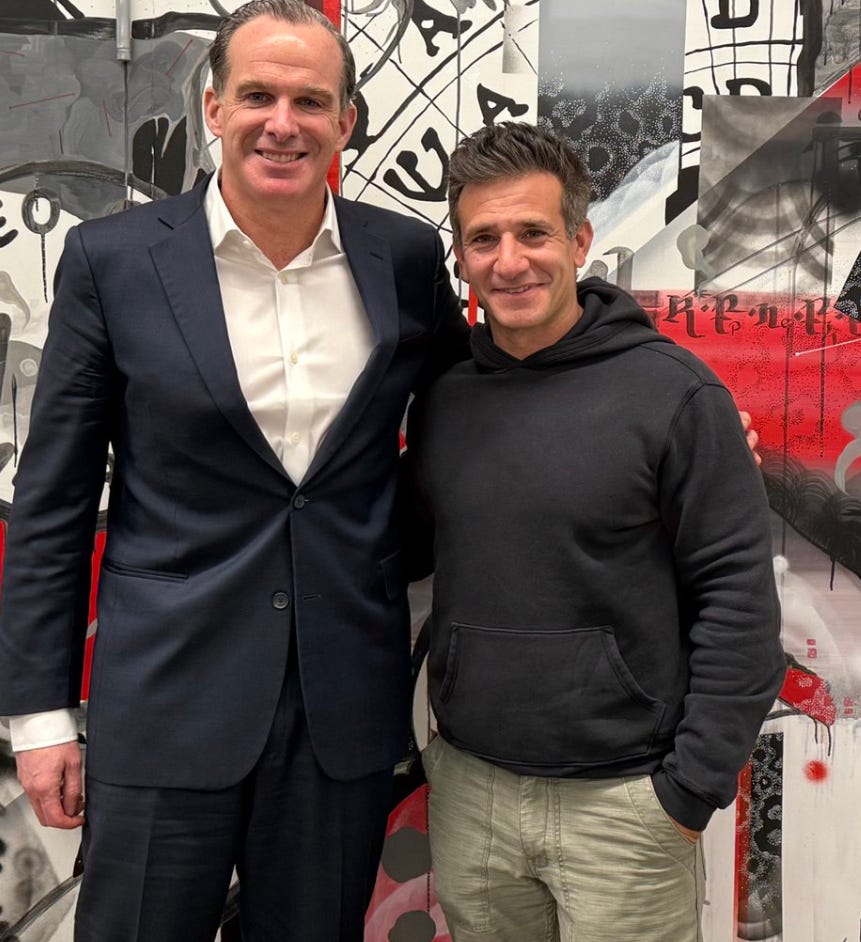
It’s not clear what McGurk does for Lux beyond being a salesman (or ambassador, if you prefer) for the firm in countries friendly to the US, but he’s not an unfamiliar face at Lux. McGurk was previously on the board of another Lux investment, Primer Technologies, which uses AI to “identify terrorist events,” according to an article in The American Prospect, which explained McGurk’s role:
Keep reading with a 7-day free trial
Subscribe to Michelle Celarier on The Billionaire Class to keep reading this post and get 7 days of free access to the full post archives.