Ackman’s 'Black Swan'
The billionaire hedge fund manager appears to have misjudged Iran’s ability to roil markets. Meanwhile, his losses are piling up.


IN THE EARLY days of the Covid crisis in 2020, hedge fund manager Bill Ackman famously went on CNBC to proclaim that “hell is coming,” arguing that the pandemic would cause such economic devastation that “America will end as we know it” unless President Trump implemented a 30-day nationwide shutdown.
Ackman was known for his ability to move markets, and, as he spoke, the Dow Jones Industrial Average index, which had already fallen 1,000 points that day, collapsed further. It ended the day down 2,000.
Unbeknownst to CNBC viewers, however, Ackman had already made billions of dollars off the crisis. Several days later he told investors in his Pershing Square Holdings hedge fund that he had just closed out a trade that earned him $2.6 billion from a $27 million bet on derivatives that would pay off if credit markets fell. And on the day of the CNBC interview, when he also mentioned several stocks he was buying, Ackman had already begun ploughing those winnings into the stock market.
The story is well known, but it bears repeating because another global crisis is upon us. Only this time Ackman appears to have been caught flatfooted when another asymmetric bet was to be had—in the oil futures market.
Moreover, this is happening at a time when Ackman, whose net worth is estimated to be about $9 billion, has become perhaps better known as a pro-war, right-wing influencer than a wily master of the markets. Indeed, his $17 billion hedge fund appears to be losing billions of dollars so far this year. And here’s the kicker; he is also trying to launch a publicly traded investment fund in the US—asking average Americans to entrust him with billions more of their dollars. (Ackman hopes to raise $10 billion.)
Past performance is no guarantee of future success, or so the disclosures go. But the past does matter. And here is why.
ACKMAN’S BIG SHORT in 2020 was controversial among those who believed he was trying to profit by torpedoing markets with his CNBC comments. He denied that, pointing out that he had mentioned in the interview that he was already buying stocks and saying the gains on his short had already been made by the time of his TV appearance. “These are bargains of a lifetime if we manage this crisis correctly,” he tweeted.
But more important, that bet restored his reputation as a brilliant investor—a reputation that had been severely tarnished when he lost $5 billion on a massive bet on the controversial Valeant Pharmaceuticals, whose business model involved raising prices sky-high on life-saving drugs. Valeant’s stock eventually collapsed amid fraud allegations.
Ackman’s Covid short showed that the billionaire still had it. Investors might be in for a rough ride at times, but Ackman was deemed astute and powerful enough to judge catastrophic events and profit from them in a way that was impossible to do by merely going into the open market and buying the dozen or so stocks his hedge fund owned. That is—or was—the most persuasive argument to pay him to manage your money.
But this year, Ackman appears to have missed the biggest move in the markets: the more than 65 percent spike in the price of oil futures following the decision by the United States and Israel to wage war on Iran.
And it isn’t because Ackman wasn’t paying attention. On X, he had been virtually begging Trump to attack Iran since January (and even before then), pleading with the president not to abandon the Iranian people. He was confident in Trump’s ability to “come to their aid” during the anti-government protests in Iran.
The following post has to be my favorite from this time. On Jan. 15, he wrote:
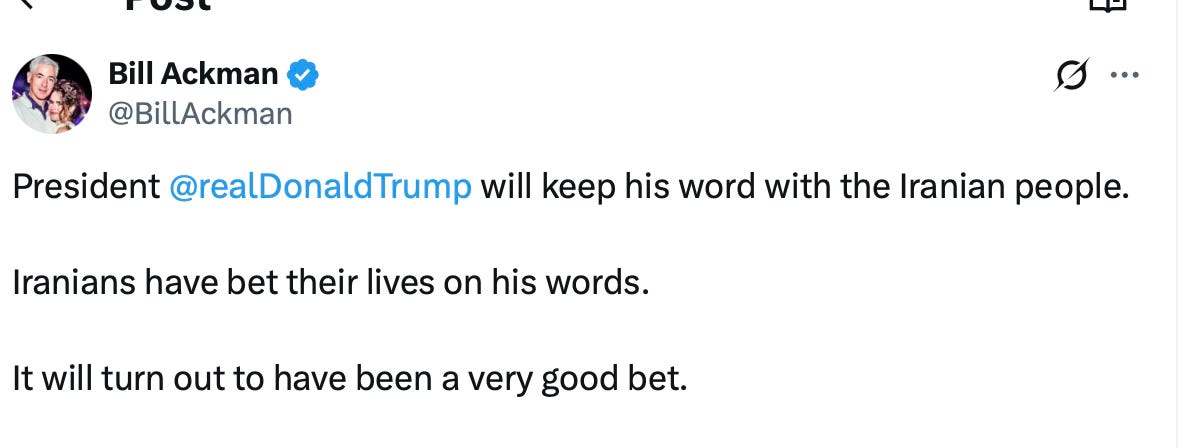
Of course it wasn’t a good bet. More than 1300 Iranians have been killed by US and Israel airstrikes since the war began, including 175 schoolgirls on the war’s first day. To date Ackman has not apologized to the Iranian people—for whom he previously expressed such concern—for the US role in killing these innocents.
And just one day before the strike on Iran, when an Oman negotiator claimed the country had made substantial concessions during talks with the US, Ackman practically screamed: “Stop negotiating.”
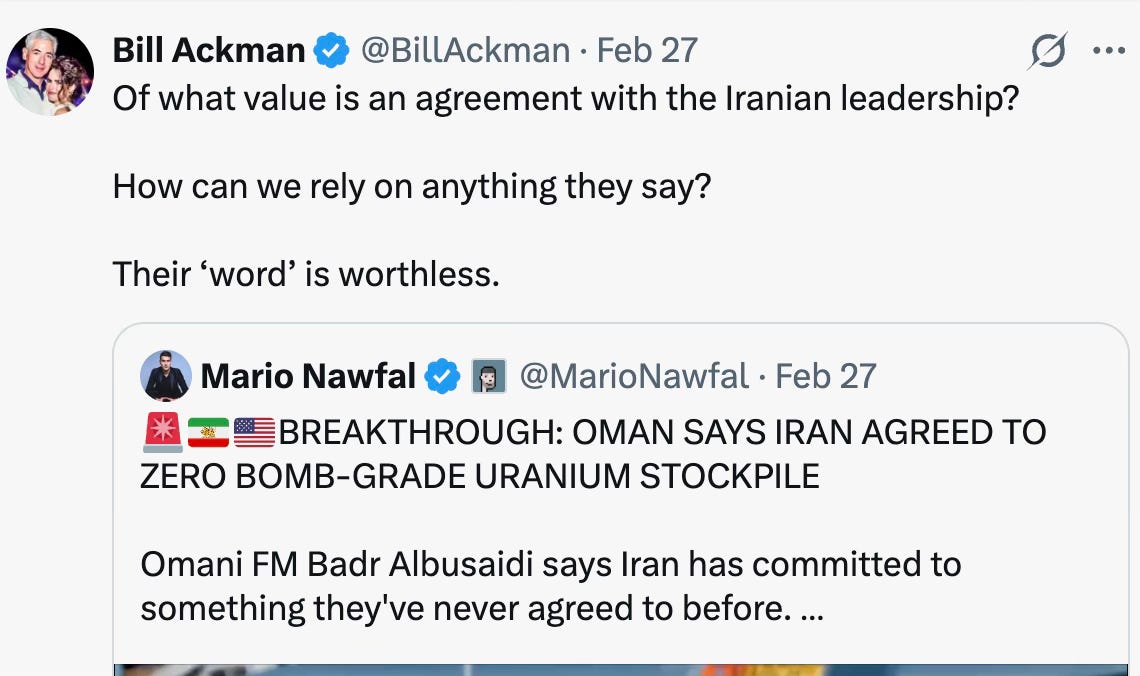
One has to wonder if Ackman, like President Trump and the people who pushed him into the war—Israeli Prime Minister Benjamin Netanyahu and the so-called “negotiators” Steve Witkoff and Jared Kushner (described as “Israeli assets” by one diplomat familiar with the talks)—have no understanding of their enemy or the geopolitical quagmire a war would create.
